

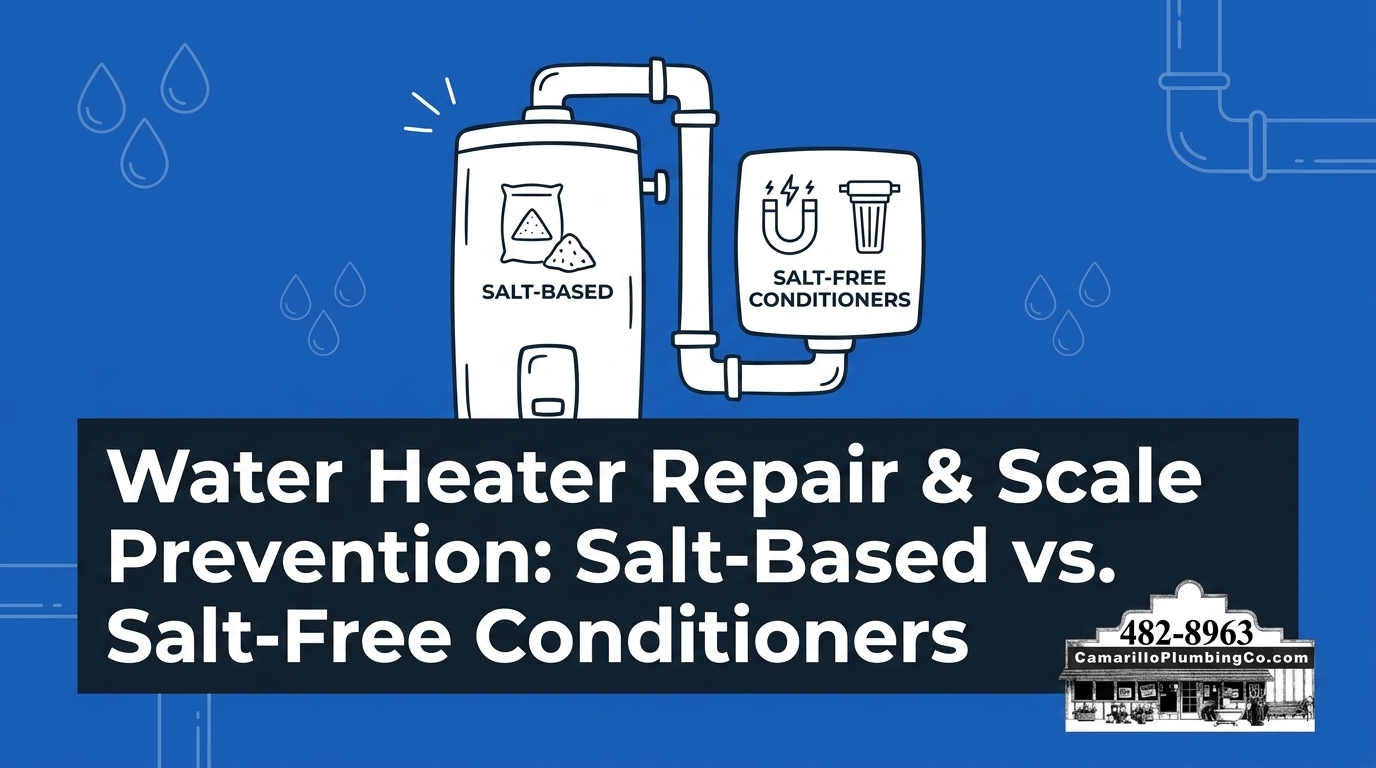
Water Heater Repair & Scale Prevention: Salt-Based vs. Salt-Free Conditioners
.avif)
Is Your Water Treatment System Secretly Failing Your Appliances?
At Camarillo Plumbing Co., one critical question we find often goes unasked when looking at options comparisons for homeowners dealing with hard municipal water is this: is your current water treatment system actually protecting your most expensive plumbing appliances? Many homeowners notice signs of premature plumbing wear—such as dropping water pressure or strange noises from the utility closet—even though they already have some form of basic water filtration installed. The reality we see in the field is that standard carbon filters do nothing to stop hard water minerals from wreaking havoc on your plumbing infrastructure.
The core problem comes down to choosing the right whole-house water treatment strategy to combat notoriously hard municipal water. You face a distinct decision point: do you prioritize complete mineral removal through a traditional salt-based system, or do you opt for maintenance-free scale prevention using a salt-free conditioner? Making the wrong choice can leave your appliances vulnerable to rapid degradation, particularly your water heater.
For more information on comprehensive home protection, explore our General Plumbing Services, or learn how we can help protect your existing tank with our professional water heater services.
The Hidden Link Between Hard Water and Water Heater Repair
To understand why your water heater is at risk, you have to look at what is actually flowing through your pipes. Municipal water supplies in Southern California frequently exceed 10 to 15 grains per gallon (GPG) of dissolved minerals, classifying them as extremely hard. Because Camarillo and Ventura County rely heavily on groundwater sources, the water naturally absorbs high levels of calcium and magnesium as it percolates through the earth. While these minerals are perfectly safe for human consumption, they are highly destructive to plumbing appliances.
When hard water enters your water heater and is subjected to high temperatures, a chemical reaction occurs. The heat causes the dissolved calcium and magnesium to precipitate out of the water. Instead of remaining suspended in the liquid, these minerals form solid, rock-like deposits known as scale. This scale settles on the bottom of the tank and coats the internal heating components.
Over time, this scale buildup drastically reduces the energy efficiency of the unit. The appliance has to burn more gas or use more electricity to heat the water through a thick layer of rock. This constant overworking is a primary catalyst for premature water heater failure. In fact, as reliable plumbers in Camarillo, our team frequently traces major appliance breakdowns directly back to inadequate hard water treatment.
How Scale Destroys Heating Elements
In our daily service calls throughout Ventura County, we see firsthand how the mechanism of destruction varies slightly depending on the type of water heater you own, but the end result is the same.
• Electric Water Heaters: In an electric tank, the heating elements are submerged directly in the water. Scale rapidly coats these elements, creating a thick insulating layer. Because the heat cannot efficiently transfer to the water, the element overheats and eventually burns out, requiring immediate replacement.
• Gas Water Heaters: In a gas unit, the burner sits beneath the tank. As scale precipitates, it falls to the bottom, creating a thick layer of sediment between the water and the heat source. The burner must heat the rock layer first, causing the steel bottom of the tank to overheat, warp, and develop microscopic stress fractures that lead to hidden, catastrophic leaks.
How Peak Summer Water Consumption Accelerates Scale Buildup
Water hardness is a year-round issue, but our technicians notice that the rate of scale accumulation is not strictly linear. It is heavily influenced by the volume of water moving through your home's plumbing system. During July peak summer water usage, high temperatures in a Mediterranean climate drive a massive increase in household water consumption. This seasonal variable places immense stress on both your plumbing system and your water treatment equipment.
The progression of accelerated scale buildup during peak demand generally follows these steps:
1. Increased Household Volume: Summer heat leads to extra showers, more frequent laundry loads, irrigation demands, and pool top-offs. The sheer volume of water entering the home doubles or even triples.
2. Higher Flow Rates: With multiple fixtures running simultaneously, water moves through the main supply lines at a much higher velocity.
3. Accelerated Precipitation: Because there is a higher volume of hard water cycling through the water heater every single day, the sheer mass of calcium and magnesium available to precipitate into scale increases exponentially.
4. System Overload: Increased flow rates test the capacity and regeneration cycles of existing water treatment systems. If a system cannot keep up with the summer flow, untreated hard water bypasses the filter and enters the water heater directly.
A water treatment system's ability to handle these high-demand periods is crucial. If your system is undersized or uses an inefficient treatment method, the summer months will rapidly accelerate the degradation of your downstream appliances.
Salt-Based Water Softeners: Complete Mineral Removal Explained
When we consult with local homeowners looking to protect their plumbing, traditional salt-based water softeners are often the first technology they encounter. These systems rely on a scientifically proven process called ion exchange. Inside the softener tank, thousands of tiny resin beads are coated with sodium ions. As hard water flows through this resin bed, the calcium and magnesium ions are physically trapped by the beads, and sodium ions are released into the water in their place.
The primary benefit of a salt-based softener is that it provides complete mineral removal. Because the calcium and magnesium are entirely stripped from the water supply before they ever reach your water heater, scale simply cannot form. This provides the absolute highest level of protection against scale-induced water heater failure, while also delivering the lifestyle benefits of softer skin, brighter laundry, and spot-free dishes.
However, we always remind our customers that this high level of protection comes with significant maintenance realities. The resin beads eventually become saturated with hard minerals and must be cleaned through a process called regeneration. This requires the homeowner to continually buy, haul, and load heavy bags of salt into the system's brine tank. Furthermore, the regeneration process flushes a heavy saltwater brine solution into the municipal sewer system. Due to the environmental impact of this brine discharge on local water reclamation facilities, some municipalities have strict regulations regarding the installation of new salt-based systems.
Maintenance Demands During High-Usage Months
The maintenance requirements of a salt-based system are directly tied to your water consumption. During high-usage summer months, the system processes more water, meaning the resin bed becomes saturated much faster. This triggers more frequent regeneration cycles. As a result, you will experience significantly faster salt consumption—requiring more frequent trips to the hardware store—and higher water waste, as the system must use dozens of gallons of fresh water to flush the brine solution through the resin bed during the backwash phase.
Salt-Free Water Conditioners: Scale Prevention Without the Salt
For our customers who want to protect their plumbing without the heavy lifting and environmental concerns of a traditional softener, salt-free water conditioners offer a modern alternative. Most high-quality salt-free systems utilize a technology known as Template Assisted Crystallization (TAC). Unlike ion exchange, TAC does not actually remove the hard minerals from the water.
Instead, as water flows through the TAC media, the dissolved calcium and magnesium ions are attracted to microscopic nucleation sites on the media granules. Here, they are forced to bond together, forming stable, microscopic crystals. Once these crystals reach a certain size, they detach and flow harmlessly through your plumbing system. Because the minerals are now in a crystallized form, they lose their ability to adhere to pipe walls, fixture aerators, or water heater elements.
The primary benefits of a salt-free conditioner revolve around convenience and efficiency. There is zero salt to purchase or load, zero wastewater generated from regeneration cycles, and minimal ongoing maintenance required. The system simply conditions the water as it flows through. However, it is important to clarify the main limitation: because the minerals remain in the water, you may still see mild water spots on glass shower doors or dishes, even though the internal plumbing infrastructure is fully protected from hard scale.
Are Salt-Free Systems Effective for Water Heaters?
Yes, TAC technology is highly effective at preventing the specific type of scale that ruins water heaters. Independent studies have shown that TAC media can reduce scale formation in heating appliances by over 90%. Furthermore, because salt-free conditioners require no electricity and do not have a backwash cycle that wastes water, they remain highly efficient and completely hands-off even during peak summer demand when water usage spikes.
Side-by-Side Comparison: Which Protects Your Plumbing Best?
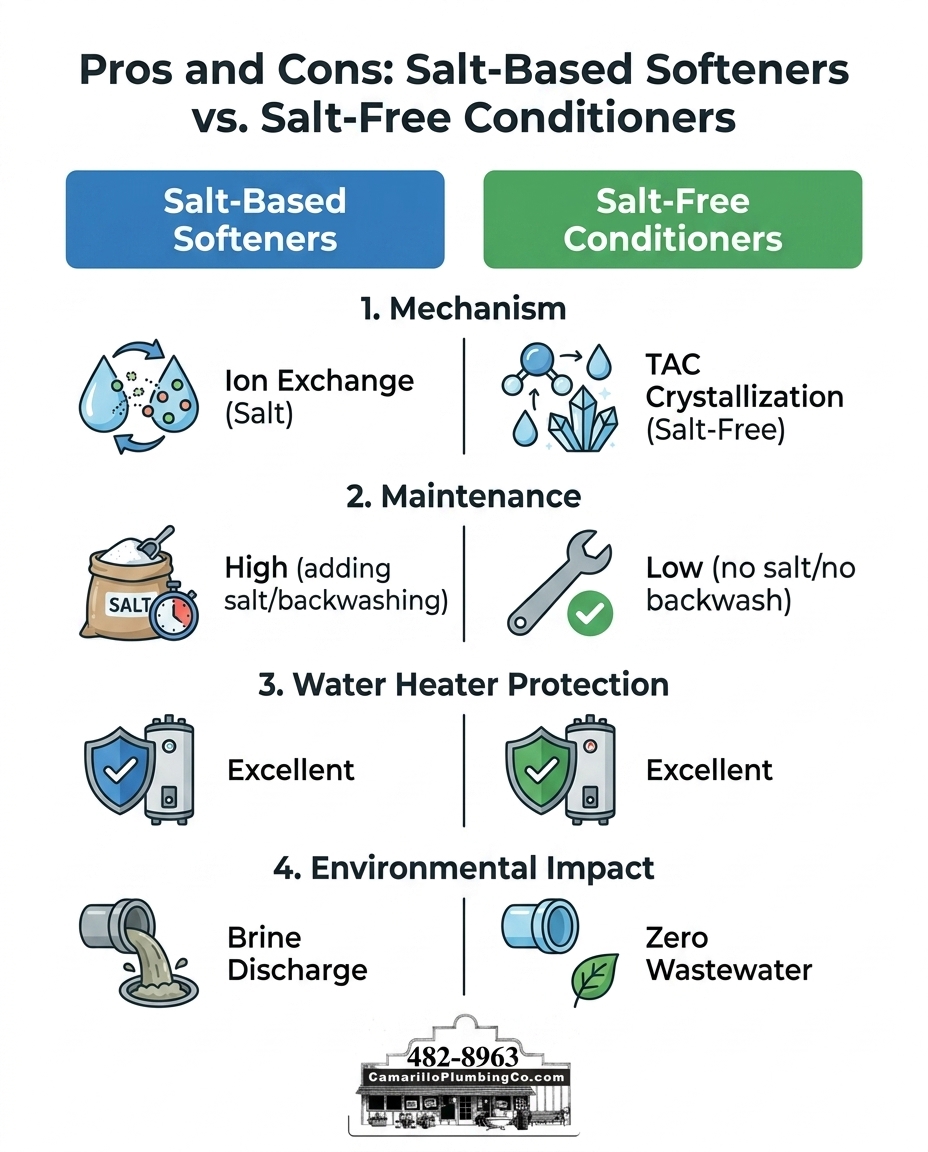
Choosing between complete mineral removal and scale prevention ultimately depends on your household priorities. Both systems effectively protect your water heater, but they go about it in vastly different ways. Our team typically walks homeowners through the key differences highlighted in the table below to help them make an informed decision.
• Primary Mechanism — Salt-Based Water Softener: Ion exchange (removes minerals) — Salt-Free Water Conditioner: TAC Crystallization (alters minerals)
• Maintenance Level — Salt-Based Water Softener: High (regularly adding heavy salt bags) — Salt-Free Water Conditioner: Low (no salt required, occasional filter changes)
• Water Heater Protection — Salt-Based Water Softener: Excellent (zero scale potential) — Salt-Free Water Conditioner: Excellent (prevents scale adhesion)
• Environmental Impact — Salt-Based Water Softener: High (brine discharge, water waste) — Salt-Free Water Conditioner: Zero (no wastewater, eco-friendly)
• Effect on Glass/Dishes — Salt-Based Water Softener: Eliminates hard water spotting completely — Salt-Free Water Conditioner: Spots may still appear, but are easier to wipe away
Comprehensive Plumbing Protection: Beyond the Water Heater
While the water heater is often the most expensive appliance affected by hard water, we frequently caution homeowners that scale doesn't just isolate itself to the utility closet. It builds up inside the entire network of supply pipes running behind your walls. Over years of exposure to untreated hard water, the internal diameter of your copper or PEX piping can slowly shrink as layers of calcification build up, severely restricting water flow to your fixtures.
This restricted flow impacts everything from your morning shower pressure to the efficiency of your dishwasher and washing machine. The tiny solenoid valves that control water intake on modern smart appliances are particularly vulnerable to getting jammed by loose sediment and scale flakes. Maintaining optimal water flow on the supply side is just as important as knowing the things you must know about drain cleaning to keep a home's plumbing balanced and functional.
Implementing a whole-house water treatment strategy—whether salt-based or salt-free—is a proactive defense for your entire plumbing ecosystem. By stopping scale at the point of entry, you protect the lifespan of your faucets, showerheads, toilet fill valves, and major appliances, ensuring your system operates at peak performance year-round.
When Preventative Measures Fail: Handling Sudden Breakdowns
If you are researching water treatment options because your plumbing is already showing signs of distress, it is important to acknowledge that prevention has its limits. If a home has run on untreated hard water for years, the damage to the water heater may already be irreversible. Scale accumulation is cumulative; once a thick layer of rock has formed at the bottom of a gas tank or calcified around an electric heating element, a simple water softener installation will not undo the existing damage.
Based on the emergency calls we field at Camarillo Plumbing Co., we advise homeowners to be vigilant in identifying the warning signs of an imminent tank failure before it results in a flooded garage or basement. Look out for these critical symptoms:
• Loud popping or rumbling noises: Often referred to as "kettling," this occurs when water gets trapped beneath a layer of sediment at the bottom of the tank, boils into steam, and violently bubbles up through the rock layer.
• Rusty or discolored hot water: This indicates that the internal glass lining of the tank has been compromised by overheating, and the steel shell is actively rusting away.
• Pooling moisture around the base: Even a small, unexplained puddle near the bottom of the unit usually means a microscopic stress fracture has formed due to sediment-induced overheating.
When these symptoms appear, having immediate access to emergency plumbing services is paramount. With 24/7 availability for emergency plumbing repairs, residents are never left without hot water when unexpected scale-induced breakdowns occur. A professional can properly diagnose whether the unit can be flushed and repaired, or if a complete replacement—ideally paired with a new treatment system to protect the investment—is necessary.
Frequently Asked Questions About Hard Water and Plumbing Repair
Do salt-free water conditioners prevent water heater scale?
Yes, salt-free conditioners are highly effective at preventing scale buildup inside water heaters. They use Template Assisted Crystallization (TAC) technology to alter the physical state of dissolved minerals, transforming them into microscopic crystals. Because the minerals are crystallized, they lose their adhesive properties and cannot stick to heating elements or tank walls.
Which water treatment is best for Southern California hard water?
The best water treatment depends entirely on your specific household goals and maintenance preferences. A salt-based softener is best if your priority is complete mineral removal to achieve softer skin and brighter laundry. Conversely, a salt-free conditioner is the best choice if your primary goal is low-maintenance, eco-friendly scale prevention to protect your plumbing infrastructure.
How does summer water usage affect water softeners?
Higher water volume during the summer means your water softener exhausts its softening capacity much faster. Because the resin bed processes more gallons of hard water due to extra showers and irrigation, the system is forced into more frequent regeneration cycles. This directly results in higher salt consumption and increased water waste as the system flushes itself more often.
Does hard water ruin water heaters?
Yes, untreated hard water is one of the leading causes of premature water heater failure. The high heat causes calcium and magnesium to precipitate out of the water, forming a rapid scale buildup inside the tank. This scale acts as an insulator, forces the unit to work significantly harder to heat the water, and ultimately leads to overheating, stress fractures, and leaks.
Can a heavily scaled water heater be repaired?
If caught early, a professional flush can remove loose sediment from the bottom of the tank and restore some efficiency. However, hardened scale that has baked onto heating elements or warped the bottom of a gas tank often requires replacing the damaged components or the entire unit, especially if the structural integrity of the tank is compromised.
Make an Informed Decision for Your Home's Plumbing
The choice between a salt-based water softener and a salt-free water conditioner ultimately comes down to balancing your personal maintenance preferences with the need for robust appliance protection. Both technologies offer excellent defense against the destructive forces of scale, ensuring that your most expensive plumbing investments are shielded from the harsh realities of local municipal water.
Protecting your water heater from scale is the ultimate goal, as it prevents sudden breakdowns, improves energy efficiency, and extends the lifespan of the unit. We encourage you to consult with our professional team to test your specific water hardness levels and inspect the current condition of your tank. To ensure your home is fully protected and operating efficiently, reach out today to schedule a comprehensive inspection and discuss our professional water heater services.
hear what our satisfied clients have to say