
Answering Common Homeowner Questions: Diagnosing Low Water Pressure and Heater Issues
.avif)

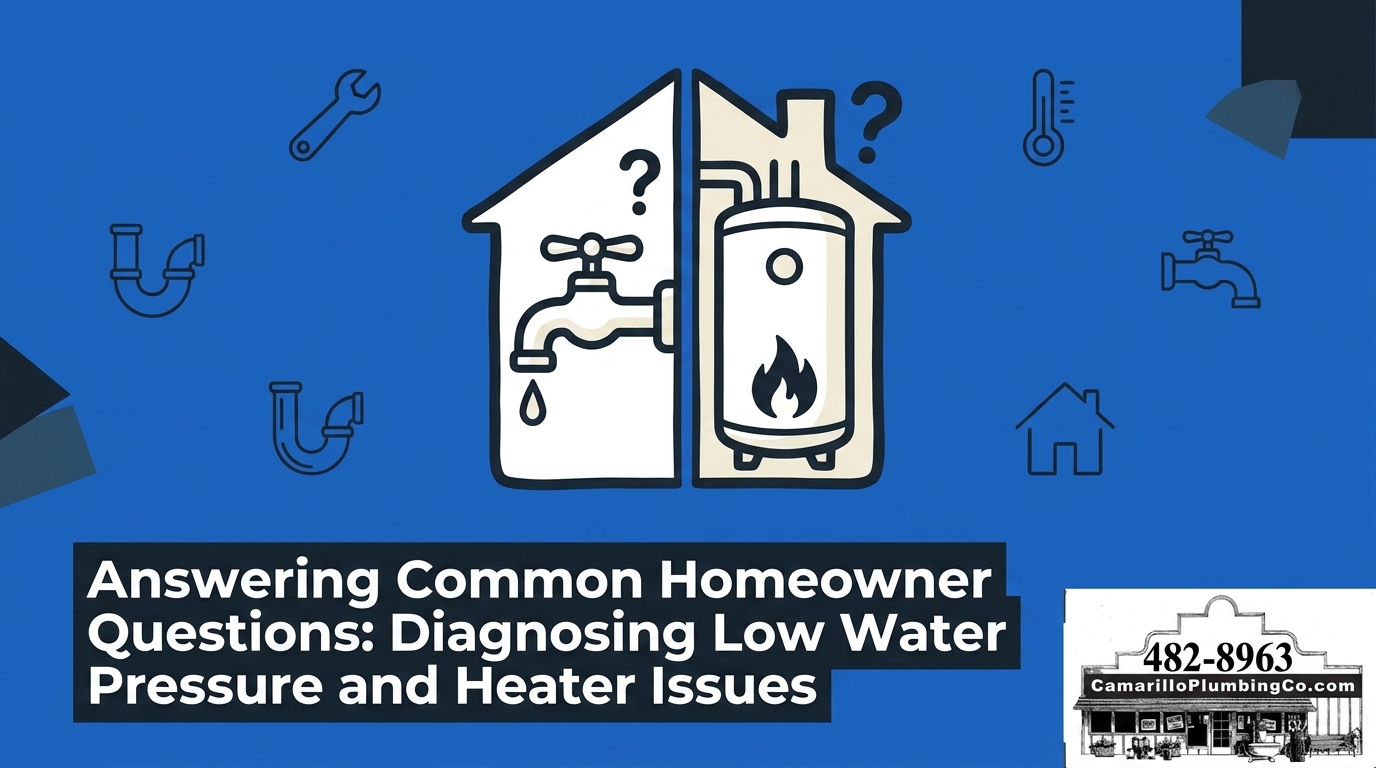
Isolating the Cause of Sudden Water Pressure Drops in Your Home: Common Homeowner Questions Answered
Are you trying to get your most common homeowner questions answered after stepping into a shower that barely trickles? You turn the handle, expecting a strong, steady stream, but instead, you get a sputtering, weak flow that makes washing soap away nearly impossible. Sudden or gradual drops in your home water pressure are incredibly frustrating. They make everyday tasks like running the dishwasher, doing laundry, or simply washing your hands take twice as long. When this happens, you are immediately faced with a critical decision point: is this a minor issue you can troubleshoot yourself, or are you looking at a systemic failure that requires a professional main line repair?
Finding the root cause of a pressure drop requires a structured, logical approach. Many homeowners rush out to buy a new showerhead or replace an expensive bathroom fixture, only to find the new hardware suffers from the exact same weak flow. The key to solving the problem is identifying whether the bottleneck is isolated to a single room or if your entire house is failing to meet the 40-60 PSI standard residential pressure. By establishing a clear baseline and testing your system step-by-step, you can prevent unnecessary spending and pinpoint exactly where the plumbing system is failing.
If you need help restoring your home's flow, explore our General Plumbing Services to see how professional diagnostics can get your system back on track.
Understanding the Baseline: What Is Normal Residential Water Pressure?
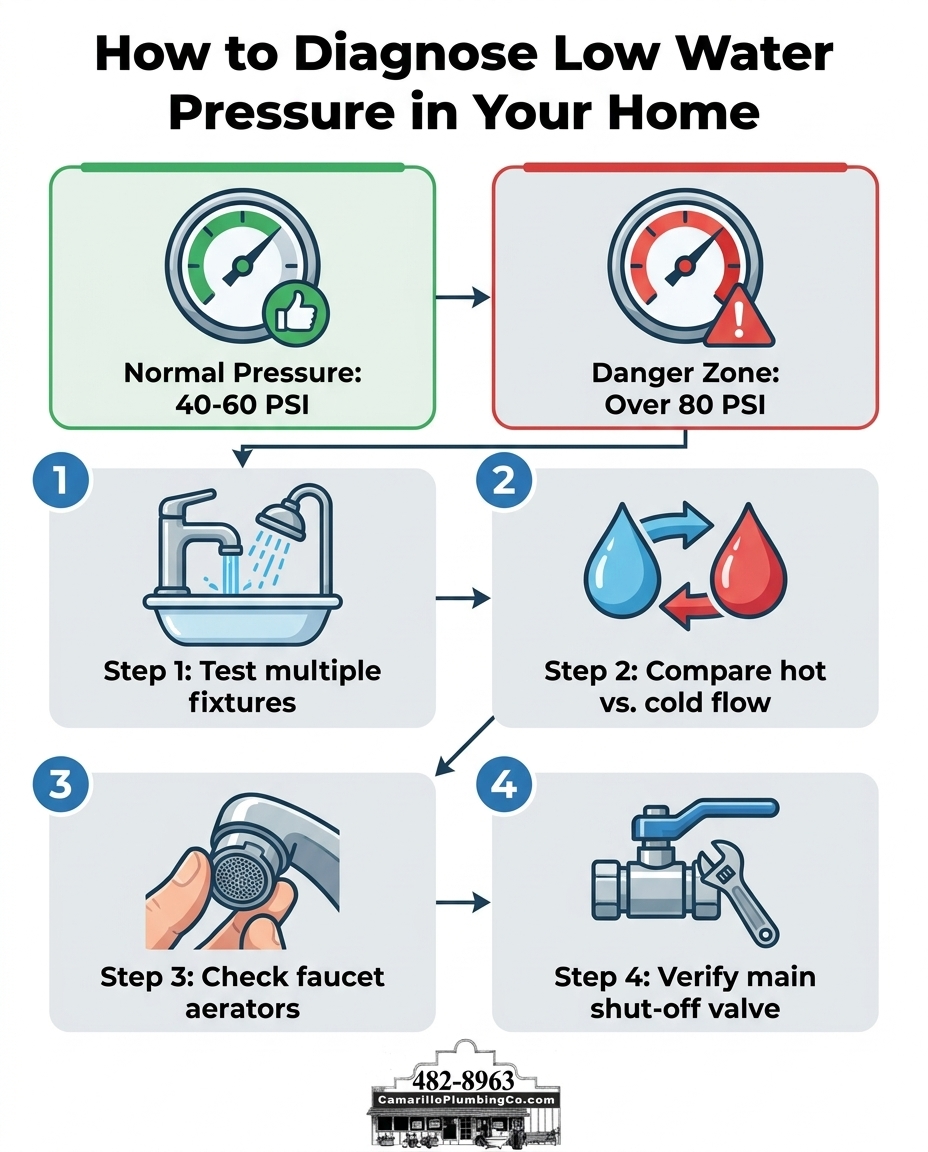
Before you can diagnose a problem with your plumbing, you need to understand what healthy operation actually looks like. The exact criteria for a healthy plumbing system are universally established by building codes and industry guidelines. According to the Uniform Plumbing Code (UPC) and Environmental Protection Agency (EPA) WaterSense guidelines, the 40-60 PSI standard residential pressure is the ideal range for a home. PSI stands for "pounds per square inch," and it measures the force with which water pushes through your pipes and out of your fixtures.
If your pressure drops below 40 PSI, you will immediately notice the symptoms. Washing machines take significantly longer to fill, garden hoses lack the power to spray across the yard, and multiple people cannot shower at the same time without the flow dropping to a trickle. However, high pressure is actually far more dangerous than low pressure. When your home's water pressure exceeds 80 PSI, it violates most local plumbing codes and puts immense stress on your entire system.
The Dangers of High Water Pressure:
• Appliance strain: High pressure forces water past the internal seals of your washing machine and dishwasher, leading to premature leaks.
• Pipe damage: Constant excessive force weakens pipe joints, increasing the risk of a catastrophic blowout behind your walls.
• Fixture wear: Faucets and showerheads will begin to drip constantly as the internal cartridges wear out faster than normal.
• Water heater stress: The thermal expansion inside a water heater combined with high incoming pressure can damage the tank. (If you suspect your tank is compromised, review our Water Heater Services for professional replacement options).
To find out exactly where your home stands, you can purchase an inexpensive water pressure gauge from any local hardware store. You simply screw the gauge onto an outdoor hose bib or a washing machine connection, ensure no water is running inside the house, and turn the valve open. The needle will instantly show you whether your home falls within the safe 40-60 PSI standard residential pressure range.
Step-by-Step: Diagnosing Single-Fixture vs. Whole-House Pressure Loss
When you notice a drop in performance, the most important step is isolating the location of the failure. A localized clog requires a completely different approach than a whole-house supply issue. Follow this systematic checklist to determine the scope of your problem before calling a professional. For more insights on keeping your system clear, read our guide on identifying and resolving stubborn drain blockages before they damage your plumbing.
1. Test multiple fixtures across different rooms. Start in the room where you first noticed the issue. Turn the faucet on full blast. Then, walk to a completely different area of the house—like a secondary bathroom or the kitchen—and test a fixture there. If the kitchen sink runs perfectly fine but the master bathroom shower is weak, you have an isolated problem. If every fixture in the house struggles to produce a strong stream, you are dealing with a systemic issue preventing your home from reaching the 40-60 PSI standard residential pressure.
2. Check hot versus cold water independently. Go to a single faucet that allows you to control the temperature separately. Turn on only the cold water and observe the flow. Turn it off, then turn on only the hot water. If the cold water blasts out at full force but the hot water barely trickles, the issue is directly tied to your water heater or the hot water supply lines, not your main water line.
3. Inspect and clean faucet aerators and showerheads. If the problem is isolated to one or two fixtures, the most common culprit is mineral buildup. The small screens inside your faucet aerators and showerheads catch debris, calcium, and scale over time. Unscrew the aerator at the tip of the faucet, rinse out any trapped grit, and soak it in white vinegar for an hour to dissolve hard water deposits. Reattach it and test the flow again.
4. Verify that the main shut-off valve is fully open. Sometimes, the simplest explanation is the correct one. If you recently had plumbing work done, or if someone bumped the main shut-off valve in your garage or utility closet, it might be partially closed. Locate your main valve. If it is a lever-style ball valve, the handle should be completely parallel to the pipe. If it is a round gate valve, turn it counterclockwise until it stops to ensure it is fully open.
Hot Water Troubleshooting: Can a Bad Water Heater Cause Low Pressure?
One of the most frequent issues homeowners face is a pressure drop that only happens when they try to take a warm shower or wash dishes. If your cold water pressure easily hits the 40-60 PSI standard residential pressure, but your hot water is weak and uncooperative, your water heater is almost certainly the bottleneck. The water heater acts as a gateway for all the hot water in your home; if water cannot flow freely through the tank, it cannot flow freely out of your faucets.
The Role of Sediment Buildup
As water enters your home, it carries microscopic dissolved minerals like calcium and magnesium. When the water heater warms this incoming supply, those minerals separate from the water and settle at the bottom of the tank as sediment. Over years of heavy use, this sediment hardens into a thick layer of scale. This scale physically blocks the water from moving efficiently through the tank's output valve. It also insulates the heating element, forcing the unit to work twice as hard to produce warm water.
Symptoms of a Failing Water Heater:
• Lukewarm output: The water never quite reaches the desired temperature, even when the dial is turned up.
• Rumbling or popping noises: As water gets trapped under the layer of hardened sediment and boils, it creates loud popping sounds inside the metal tank.
• Sudden pressure drops: The hot water flow starts strong for a few seconds, then immediately drops to a trickle.
• Discolored water: Hot water that looks rusty or brown indicates internal tank corrosion.
Severe water heater failures are not just an inconvenience; they are a property risk. A heavily corroded tank can rupture, flooding your garage or utility room in minutes. Because these critical failures rarely happen during convenient business hours, Camarillo Plumbing Co. offers 24/7 emergency availability, ensuring homeowners are not left without hot water or facing water damage during the night. If you notice signs of an imminent tank failure, reach out to our Emergency Plumbing Services immediately.
The Hidden Culprit: How Pressure Reducing Valve (PRV) Failures Affect Your System
If you have ruled out localized clogs and water heater bottlenecks, and your entire house is experiencing sudden pressure fluctuations, the most likely culprit is a failing Pressure Reducing Valve (PRV). In our years serving Camarillo neighborhoods, our team typically sees PRV degradation as the number one cause of unexplained, whole-house flow issues. This bell-shaped brass valve is typically installed on the main water line right where it enters your home.
The Problem: Unpredictable and Damaging Flow
Municipal water towers and city pumps push water through street mains at extremely high pressures—often well over 100 PSI—to ensure it reaches every neighborhood and fire hydrant. If that raw municipal pressure entered your home directly, it would blow out your pipe joints and destroy your appliances. The PRV exists to step down that intense street pressure to the safe 40-60 PSI standard residential pressure. When the PRV fails, your home is subjected to wild fluctuations.
The Cause: Internal Degradation
Inside the PRV is a heavy-duty spring and a rubber diaphragm. As water pushes against the diaphragm, the spring regulates how much water is allowed to pass through. Over years of constant use, hard water minerals calcify on the internal spring, and the rubber diaphragm becomes brittle and tears. Once the internal mechanism fails, the valve either gets stuck in a nearly closed position (causing a severe drop in house-wide flow) or gets stuck wide open (flooding your home with dangerous 100+ PSI street pressure).
The Solution: Professional Replacement
Symptoms of a bad PRV include sudden whole-house pressure drops, incredibly high pressure that makes faucets spray aggressively, and loud banging noises in the walls known as water hammer. Because the PRV is tied directly to the municipal supply line, replacing it is absolutely not a DIY job. It requires cutting into the main water line, soldering new copper or pressing new fittings, and carefully calibrating the new valve to ensure it maintains the exact 40-60 PSI standard residential pressure required by local building codes. A licensed professional must handle this replacement to protect your home.
Summer Peak Demand: How July Irrigation Strains Municipal Supply Lines
Sometimes, the cause of your weak shower has nothing to do with the pipes inside your home. External climate factors and neighborhood habits play a massive role in how water flows to your property. During the peak summer months, particularly when July heat sets in across the region, residential water usage skyrockets. In fact, our team frequently fields calls this time of year from homeowners assuming their main line has failed, when in reality, the neighborhood is just running irrigation systems simultaneously. Homeowners run their sprinklers, fill swimming pools, and wash cars far more frequently.
This massive surge in outdoor irrigation often increases a neighborhood's total water consumption by 30-70%. When hundreds of homes in the same subdivision run their automated sprinkler systems at 6:00 AM, it places an immense strain on the municipal supply lines. The city pumps simply cannot keep up with the simultaneous demand. As a result, the street pressure drops temporarily, which means the flow entering your home drops below the 40-60 PSI standard residential pressure, regardless of how well your PRV is functioning.
To differentiate between a temporary municipal drop and a permanent plumbing failure, you need to test your water pressure during off-peak hours. Try running your shower or checking your outdoor hose bib with a gauge at 1:00 PM or late at night. If the pressure returns to normal during these off-peak times, your plumbing system is likely perfectly fine, and you are just experiencing the effects of summer neighborhood demand. If the pressure remains terribly low at 2:00 AM, you have a genuine hardware failure that requires professional attention. For local expertise in diagnosing these regional demand issues, contact our Plumbers in Camarillo CA.
Frequently Asked Questions About Home Water Pressure and Heating
Why is my water pressure suddenly low?
Sudden drops are typically caused by a failing PRV, a partially closed main shut-off valve, or a municipal supply issue in your neighborhood. If the drop happens instantly across every fixture, the main supply line is the culprit. Testing multiple fixtures in different rooms helps determine if the issue is isolated to one faucet or if it affects the whole house.
How do I test my home water pressure?
You can test your system by attaching a simple, inexpensive pressure gauge to an outdoor hose bib or a washing machine connection. Ensure no water is running inside the house—including dishwashers and ice makers—to get an accurate static reading. Turn the valve fully open and read the dial to see if your home falls within the safe 40-60 PSI standard residential pressure range.
How do I know if my PRV is bad?
Symptoms of a failing PRV include wildly fluctuating pressure, water hammer noises (loud banging in the walls when a faucet is turned off), or gauge readings that fall far outside the 40-60 PSI standard residential pressure range. If your pressure is inexplicably high one day and barely trickling the next, the internal diaphragm of the valve has likely torn.
Why is my hot water pressure lower than cold?
This specific symptom indicates a bottleneck at the water heater rather than an issue with your main water line. It is often due to severe sediment buildup inside the tank, a partially closed output valve, or a failing unit that restricts flow. Flushing the tank annually can help prevent this scale buildup and restore proper flow.
What is normal residential water pressure?
Normal pressure is strictly defined as being between 40 and 60 PSI. This range provides adequate, comfortable flow for daily tasks without damaging pipes, blowing out fixture seals, or putting undue stress on your appliances. Anything consistently above 80 PSI requires immediate professional correction to prevent catastrophic leaks.
Taking the Next Step to Restore Reliable Water Pressure
Dealing with a weak shower or a slow-filling washing machine disrupts your entire daily routine. While cleaning out a clogged faucet aerator is an easy afternoon task, diagnosing a failing PRV or a choked water heater requires a deeper understanding of how your plumbing system operates. Maintaining the 40-60 PSI standard residential pressure is vital for the longevity of your pipes, the health of your appliances, and your overall comfort at home.
If you have walked through the diagnostic steps, tested your hot and cold lines, and verified your main shut-off valve is open, but you are still experiencing poor flow, it is time to bring in an expert. Do not let a failing valve turn into a flooded garage. Getting your most common homeowner questions answered by a licensed professional ensures your home remains safe, efficient, and fully functional.
hear what our satisfied clients have to say