
Sewer Line Replacement in Fillmore, CA
.avif)

When a sewer line fails in Fillmore, CA, the problem affects more than plumbing — it affects yard condition, indoor health, and property value. Fillmore homes often sit on older lots with mature trees and soil types that accelerate pipe damage. Camarillo Plumbing explains your sewer line replacement options and the full process so you can choose the right solution with confidence and minimal property impact.
Why sewer line replacement matters for Fillmore homeowners
- Persistent backups, foul odors, or repeatedly clogged drains usually point to a damaged main sewer line.
- Older clay or cast iron pipes common in historic Fillmore neighborhoods are vulnerable to root intrusion, corrosion, and offset joints.
- Local soil movement after heavy winter rains, root systems from citrus and oak trees, and seasonal groundwater can speed deterioration.
Timely replacement prevents ongoing repairs, health hazards, and costly structural damage.
Common sewer line problems we diagnose
- Root intrusion causing blockages and cracks
- Collapsed or severely cracked pipe from age or shifting soils
- Corroded cast iron or oxidized metal with widespread leaks
- Bellies and sagging sections that trap solids
- Offset joints and broken connections after ground settling
- Repeated grease and debris buildup indicating poor slope or damaged pipe
Initial diagnostics: sewer camera inspection and leak detection
- Sewer camera inspection: A high-definition camera travels the full length of the lateral to record cracks, roots, bellies, joint separation, and exact footage of damage. Camera reports give a precise plan for repair versus replacement.
- Leak detection: Acoustic and tracer methods locate active leaks that may not be visible on camera, especially under slabs or beneath landscaping.
Diagnostics determine whether a targeted repair, trenchless replacement, or full excavation is the most reliable solution.
Evaluating pipe condition and selecting the approach
Technicians evaluate pipe material, diameter, length, depth, lateral connections, and surface access. Key considerations for Fillmore properties include proximity to mature trees, irrigation lines, driveways, and historic landscaping. The most common replacement choices:
- Trenchless pipe lining (CIPP): A cured-in-place liner restores structural integrity by creating a seamless inner pipe. Best when the existing line remains largely continuous and lateral reconnections can be managed.
- Pipe bursting: The old pipe is fractured and simultaneously replaced with a new pipe pulled through. Ideal when the existing line is collapsed but continuous access between start and end pits is possible.
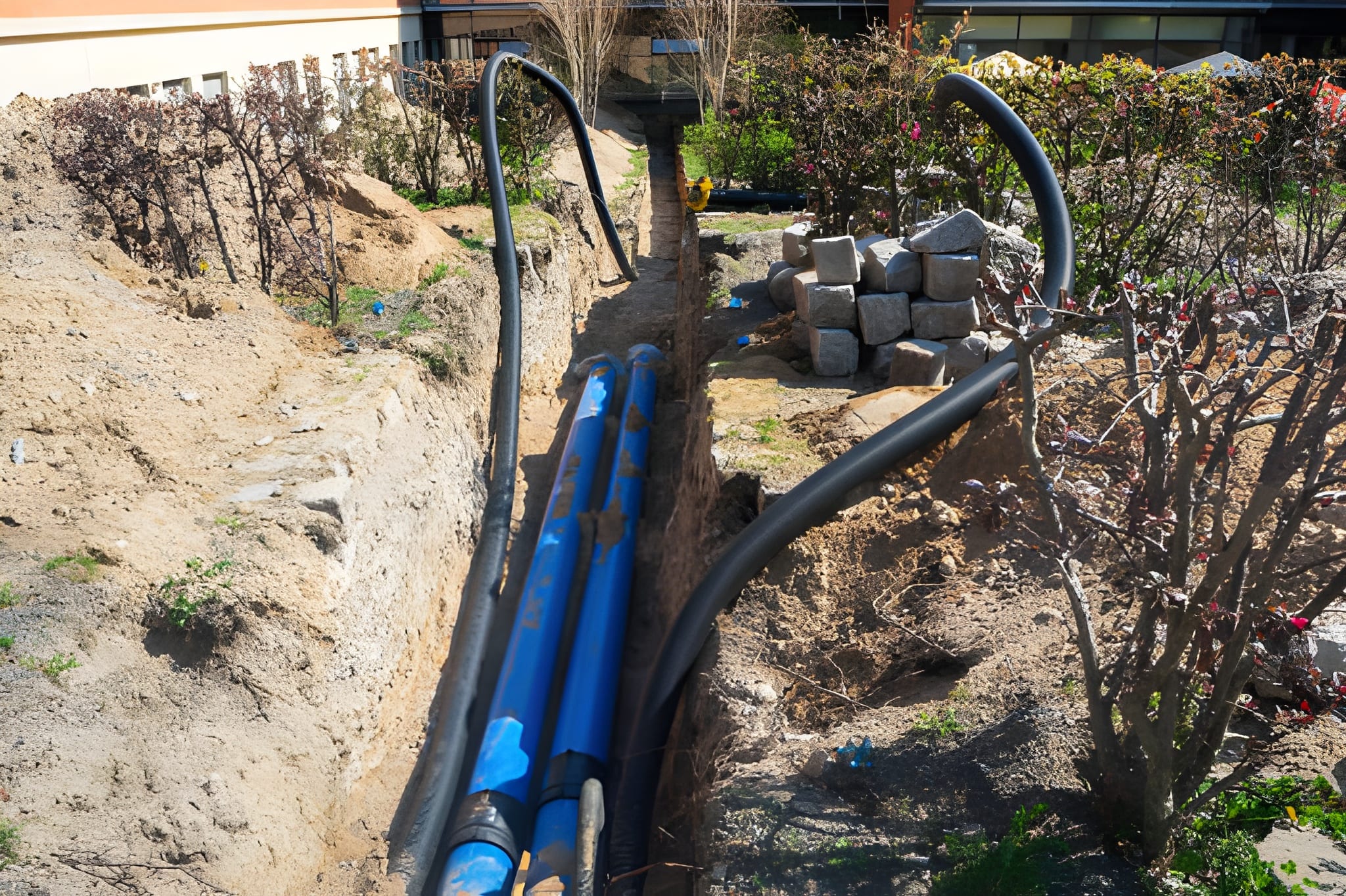
- Traditional excavation: Full dig-and-replace is chosen when pipes run under porches, major obstacles, or when lateral connections and severe offsets require open access.
Trenchless versus traditional excavation — pros and cons
- Trenchless benefits: minimal surface disruption, faster completion, less landscape and hardscape restoration, reduced root cutting, and often lower overall restoration expense.
- Trenchless limitations: not always possible for severely collapsed or offset lines, or when multiple lateral reconnections under structures are required.
- Excavation benefits: full access to the pipe for complex repairs or rerouting, ability to replace multiple laterals and remediate deep structural problems.
- Excavation drawbacks: longer timelines, greater landscape and hardscape impact, and more extensive restoration needs.
Typical timelines — step by step
Trenchless pipe lining (typical residential job)
- Pre-inspection and permitting: 1 to 5 business days depending on local approvals.
- Camera inspection and prep: same-day.
- Set up entry and exit points (small pits): a few hours.
- Liner installation and cure time: 4 to 8 hours.
- Final camera verification, backfill, and surface clean-up: remainder of day.
Total: often completed in 1 to 2 days.
Pipe bursting
- Permitting and prep: 1 to 5 business days.
- Small excavation for access pits: 1 day.
- Pipe bursting and new pipe pull-through: 1 day.
- Backfill, compaction, and surface restoration: 1 to 2 days.
Total: typically 2 to 4 days.
Traditional excavation
- Permitting and locating underground utilities: 2 to 7 business days.
- Full trenching and pipe removal: 1 to several days depending on scope.
- New pipe installation and lateral reconnections: 1 to several days.
- Backfill, compaction, and full landscaping or hardscape restoration: several days to weeks for planted areas to settle.
Total: several days to multiple weeks for complex jobs.
Site restoration and landscaping considerations
- Trenchless methods greatly reduce damage to lawns, mature trees, irrigation systems, patios, and driveways.
- When excavation is necessary, restoration tasks include regrading, sod replacement, irrigation repair, tree root remediation, and hardscape repair. Compaction and proper soil amendments are used to avoid future settling.
- For properties with historic landscaping, careful root mapping and selective root pruning are part of the plan to preserve tree health.
Permits and code compliance in Fillmore
Permits are typically required for sewer lateral replacement and abandonment. Work must comply with local building and plumbing codes and pass inspections for proper slope, materials, and connections. Coordination with the City of Fillmore or Ventura County public works is often part of the process, and licensed plumbers follow accepted standards for trench depth, backfill compaction, and lateral reconnection.
Cost factors and financing options
Primary cost drivers:
- Line length, depth, and accessibility
- Pipe material chosen (PVC, HDPE, lined CIPP)
- Need for lateral reconnects, manhole or cleanout upgrades
- Surface restoration complexity (driveways, patios, mature landscaping)
- Permitting, utility locates, and unforeseen structural obstacles
Financing options commonly include flexible payment plans, home improvement loans, or third-party financing to help manage larger projects without deferring necessary work.
Expected disruption and cleanup
Expect crews, equipment, and temporary noise. Trenchless jobs are quieter and shorter; excavation creates more visible disruption but crews follow protocols to protect property and clean up debris. Standard cleanup includes hauling off old pipe, restoring disturbed soil, replacing sod or mulch, and safety checks before final sign-off.
Warranties and maintenance recommendations
- Warranties typically cover workmanship and materials; trenchless liners often carry both manufacturer and installer guarantees.
- Recommended maintenance: annual or biennial sewer camera inspection, routine hydro jetting if roots or buildup are recurring, root barrier installation near vulnerable lines, and avoiding grease or heavy solids disposal in drains. Regular maintenance extends the life of new sewer installations.
Case studies — minimal property impact examples
Case study 1: In a historic Fillmore neighborhood, an older clay main with severe root intrusion was replaced using pipe lining. Camera inspection identified the damaged section, and the liner cured in place within a single day. The lawn and mature citrus tree required only minor sod replacement, and full flow was restored with minimal visible impact.
Case study 2: A mid-century home experienced repeated collapses under a landscaped driveway. Pipe bursting allowed a new HDPE pipe to be installed without removing the driveway slab. Two small access pits were used; the driveway stayed intact and only asphalt patched areas were required.
FAQsQ: How do I know if trenchless replacement is an option for my Fillmore home?A: A thorough camera inspection and evaluation of lateral connections determine trenchless eligibility. Trenchless is ideal when the line is continuous and access points are available.
Q: How long will my property be disrupted?A: Trenchless projects can be completed in 1 to 2 days with minimal disruption. Traditional excavation may require several days to weeks depending on restoration needs.
Q: Are permits required in Fillmore?A: Yes. Most sewer replacements require permits and inspections through the city or county to ensure code compliance and proper reconnection.
hear what our satisfied clients have to say