
Sewer Line Replacement in Woodland Hills, CA
.avif)

Sewer line problems in Woodland Hills homes can quickly disrupt daily life and damage landscaping, foundations, and property value. Timely sewer line replacement restores reliable wastewater flow and prevents recurring backups and health hazards. Camarillo Plumbing brings decades of residential and commercial plumbing experience to Woodland Hills, addressing common local causes like tree root intrusion, older clay piping, and soil movement from seasonal drought and seismic activity.
Common signs you need sewer line replacement in Woodland Hills
- Repeated basement or floor drain backups despite clearing the drain.
- Multiple slow drains across the home at the same time (sinks, tubs, toilets).
- Foul sewage odors in the yard, crawlspace, or near cleanouts.
- Sunken or spongy spots, sinkholes, or unusually lush patches of grass over the line.
- Gurgling sounds in toilets or drains after other fixtures run.
- Visible sewage surfacing in landscaping or near the foundation.
- Frequent root intrusion found during hydro jetting or camera inspections.
Diagnostic process: how we pinpoint the problem
- Initial assessment: review of symptoms, history of backups, and visible yard issues.
- Sewer camera inspection: a high-definition camera fed through the cleanout or access point records pipe condition, joint failures, fractures, root masses, offset pipes, and blockages. The camera can be sonde-located to map exact depth and position.
- Leak detection and pressure testing: when active leaks or breaches are suspected, we use smoke testing, water isolation tests, and electronic leak detection to verify leaks and identify inflow points.
- Determination of repair vs replacement: diagnostics establish whether a targeted repair or a full replacement is the long-term solution based on pipe material, number of failures, alignment, and age.
Replacement methods: trenchless vs open-cut excavation
- Trenchless options (preferred when feasible)
- Pipe lining (Cured-In-Place Pipe, CIPP): installs an epoxy-saturated liner inside the existing pipe to create a new pipe-within-a-pipe. Minimal digging, ideal for pipes with longitudinal cracks, root intrusion, or joint separation where host pipe is mostly intact.
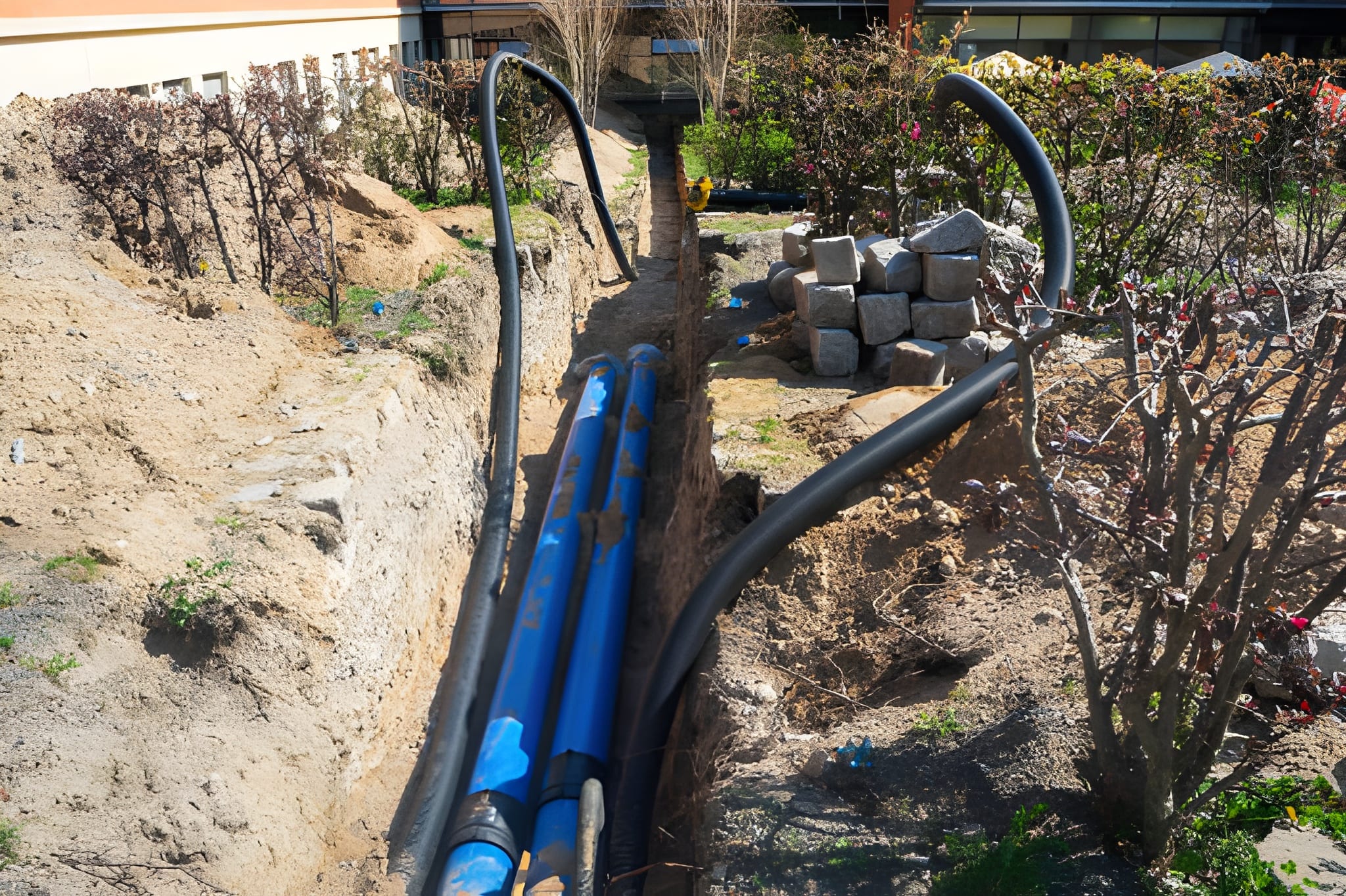
- Pipe bursting: ruptures the old pipe while pulling a new high-density polyethylene (HDPE) or PVC pipe into place. Best when full replacement is required but surface disruption must be minimized.
- Typical benefits: less landscape and hardscape disruption, faster completion (often 1-3 days), reduced restoration costs.
- Open-cut (traditional excavation)
- Full-depth trenching and replacement with new pipe material. Required when the pipe is severely collapsed, misaligned, or when lateral connections and depth require open access.
- Typical impacts: more excavation, longer timelines (several days to a week or more depending on restoration), greater need for landscaping and paving repair.
Step-by-step replacement workflow
- Pre-job evaluation and camera inspection to map the line and locate laterals.
- Utility locating and permits: locate all underground utilities and obtain required permits from local authorities.
- Method selection and job planning: choose trenchless or open-cut based on diagnostics, access, and cost factors.
- Site preparation: protection of landscaping, setting up traffic control if work impacts driveways or the public right-of-way.
- Replacement or lining work: trenchless installation or excavation and new pipe placement. Reconnect laterals and service lines.
- Testing and final camera inspection: pressure testing, leak checks, and video documentation to confirm proper flow and seals.
- Backfill, compaction, and paving or landscape restoration.
- Final paperwork and warranty documentation.
Expected timelines and permitting considerations
- Camera inspection and initial estimate: often completed same day or within 24-48 hours.
- Permitting: local building and street permits in Woodland Hills (City of Los Angeles jurisdictions) may add time; permit turnaround commonly ranges from a few days to a couple of weeks depending on scope and whether street cuts are required.
- Replacement duration: trenchless projects frequently finish in 1-3 days for typical lateral runs; open-cut replacements can take 3 days to 2+ weeks depending on depth, length, number of laterals, and restoration needs.
Typical cost factors and financing/options
- Key cost drivers:
- Total length of pipe to replace and depth.
- Pipe material selected (CIPP, HDPE, PVC).
- Accessibility (yard only versus street-to-house runs).
- Number of lateral reconnections and cleanouts required.
- Presence of heavy root intrusion or collapsed sections.
- Required permits, street cuts, asphalt or concrete replacement, and landscaping restoration.
- Financing and payment options: many homeowners use project financing, home improvement loans, or payment plans to spread replacement costs. Discussing financing options with a contractor can help match the approach to budget and timeline needs.
Site restoration and landscaping repair
- Standard restoration includes compacted backfill to prevent future settling, topsoil replacement, re-sodding or hydroseeding, and irrigation repair.
- Hardscape repairs may involve concrete replacement, driveway or walkway repaving, and regrading to match existing slopes.
- For large landscaping features or mature trees, coordinated restoration plans often include staged replanting and using root barriers to protect the new line.
Materials, warranties, and longevity
- Common materials:
- HDPE: durable, flexible, and ideal for seismic areas; commonly used with pipe bursting.
- PVC: rigid and cost-effective for open-cut replacements.
- CIPP liners: epoxy-based materials that restore existing pipe hydraulics.
- Warranties:
- Manufacturer warranties vary by material and liner system, frequently ranging from 15 to 50 years for CIPP and HDPE products.
- Workmanship warranties from the contracting plumber typically cover labor and installation defects for a stated period; request written warranty details for both materials and labor.
Post-replacement maintenance recommendations
- Schedule a camera inspection at 1 year and then every 3-5 years to confirm performance.
- Avoid flushing wipes, grease, and non-biodegradable items that can stress laterals or cause blockages.
- Maintain trees and install root barriers where large roots near the line were an issue.
- Keep cleanouts accessible and consider installing an exterior cleanout if none exists to simplify future maintenance.
- Periodic hydro jetting can help prevent root regrowth and buildup in older systems.
Q: How do I know if trenchless replacement is an option for my Woodland Hills property?A: A sewer camera inspection and utility locate determine if trenchless methods are feasible. Trenchless works when the pipe runs are accessible at both ends, the existing pipe is not completely collapsed, and lateral reconnections can be handled with minimal excavation.
Q: Will replacing my sewer line require a street cut or city permit in Woodland Hills?A: Many projects that cross the public right-of-way or require driveway/curb cuts will need permits from local authorities. Permit requirements vary by scope and location; a licensed plumber will secure necessary permits and coordinate inspections.
Q: How long after replacement can I use my drains normally?A: After final testing and reconnection, drains are typically usable immediately. Allow any restored landscaping and pavement to cure as directed by your contractor before heavy traffic or irrigation resumes.
Q: What warranties should I expect on a new sewer line?A: Expect a manufacturer warranty on pipe materials or liners and a separate workmanship warranty from the installer. Warranty lengths vary by product and installer; get both in writing.
Q: Can roots cause the same problems again after replacement?A: New pipe materials like HDPE or properly installed CIPP are root-resistant, but roots can re-invade at junctions or through nearby landscaping. Root barriers and regular maintenance reduce recurrence.
hear what our satisfied clients have to say