

Sewer Line Replacement in Agoura Hills, CA
.avif)

Sewer line failure is one of the most disruptive and unsanitary problems a homeowner can face. In Agoura Hills, CA, older clay pipes, invasive tree roots, shifting soils on hillside lots, and periodic heavy winter rains increase the risk of recurring backups, slow drainage, and collapsed laterals. Camarillo Plumbing brings experienced diagnostics and both trenchless and open-trench replacement options to help Agoura Hills homeowners restore reliable sewer service with minimal disruption and long-term reliability.
When replacement is recommended versus repair
Knowing whether a sewer lateral needs full replacement or a targeted repair starts with diagnosing the underlying cause. Replacement is typically recommended when one or more of the following are present:
- Recurrent blockages from root intrusion that are not resolved by repeated cleaning
- Multiple repairs within a short period or long runs with widespread deterioration
- Collapsed or badly broken pipe segments revealed by camera inspection
- Pipe materials at the end of their service life (very old clay, cast iron with advanced corrosion)
- Severe offsets or bellied sections where slope is compromised and flow is impaired
- Lateral separation from the main or repeated sanitary sewer overflows
Repairs (hydro jetting, sectional repairs, or cured-in-place lining) are appropriate when damage is localized and the remaining pipe is structurally sound. A sewer camera inspection is the critical first step to determine which path is the most durable and cost-effective for your home in Agoura Hills.
Pre-replacement inspection and planning
A careful pre-replacement assessment reduces surprises and shortens project time:
- Video sewer camera inspection to locate defects, measure depth, and identify root locations.
- Dye testing or smoke testing to confirm connections and locate inflow sources.
- Utility locates (811) and on-site verification to map water, gas, electric, and irrigation lines.
- Soil and slope evaluation for hillside properties to plan access and shoring if needed.
- Permit review and scope planning — coordinate with the City of Agoura Hills and Los Angeles County as required for lateral abandonment, main tie-in, and inspections.
Comprehensive planning lets crews determine trenchless feasibility, select materials, and prepare a restoration plan that respects mature landscaping common to Agoura Hills properties.
Trenchless versus open-trench methods
Two primary approaches are used for sewer line replacement:
Trenchless methods (preferred where feasible)
- Pipe bursting: The existing pipe is fractured outward while a new HDPE or PVC pipe is pulled into place. Best where minimal surface disruption matters — narrow yards, driveways, or mature landscaping.
- Cured-in-place pipe (CIPP) lining: A resin-saturated liner is inverted or pulled into the existing pipe and cured to form a new structural pipe inside the old one. Ideal for continuous runs with no major collapse.Benefits: Reduced excavation, faster completion, minimized landscape and driveway damage, and lower overall disturbance.
Open-trench replacement
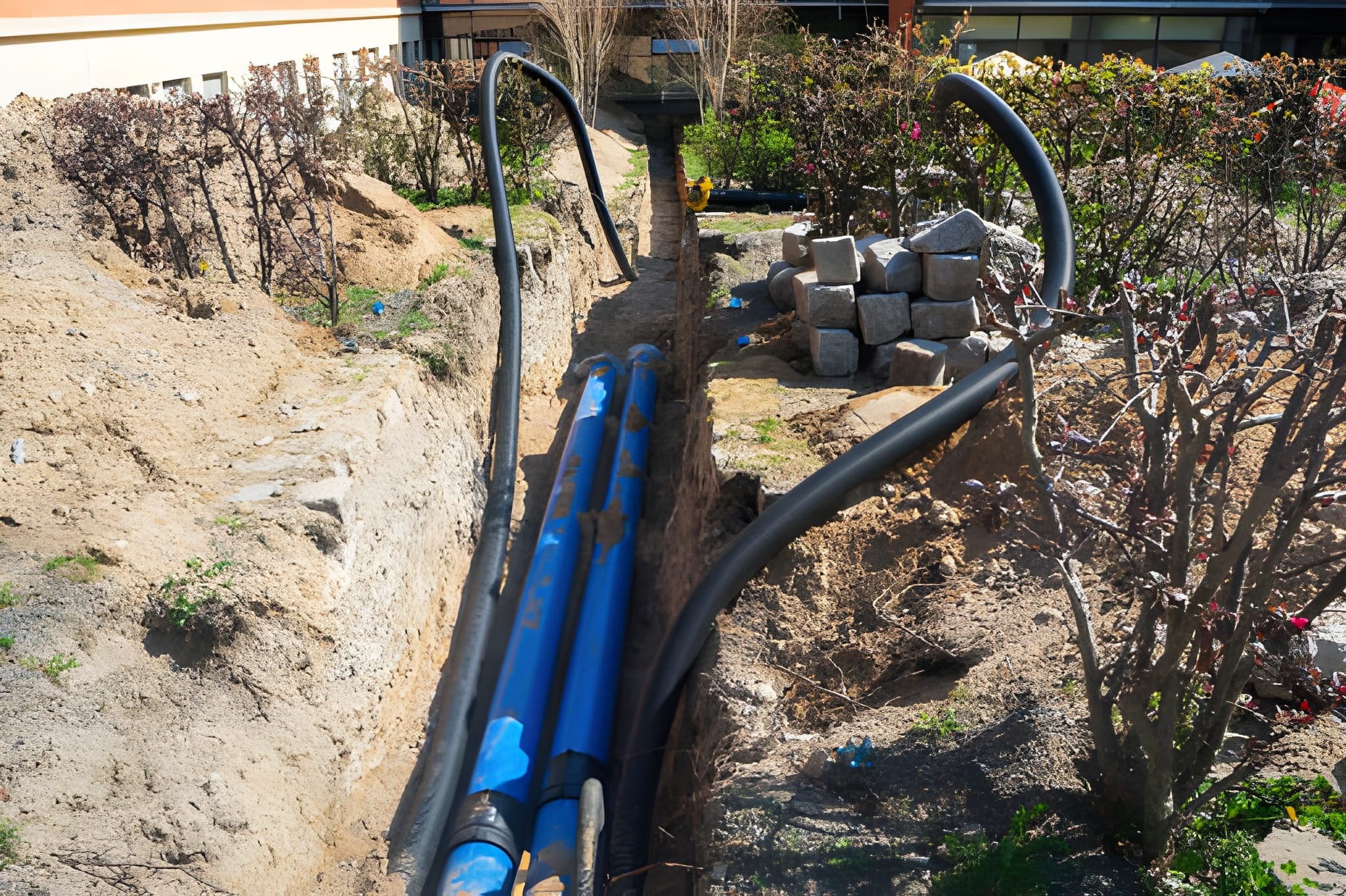
- Full excavation of the line and installation of new pipe on a prepared bed.Benefits: Preferred for severely collapsed pipes, multiple service connections, large diameter changes, or sections that cannot be accessed with trenchless equipment.Open-trench work allows full replacement and slope correction but involves more restoration work for turf, hardscape, and irrigation.
Materials and warranties
Common pipe choices for replacements include:
- PVC (SDR or Schedule): Smooth flow, widely used for residential laterals, resistant to corrosion.
- HDPE: Flexible and durable, excellent for pipe bursting or long life in challenging soils.
- Ductile iron or cast iron (in select circumstances): Used when higher load-bearing strength is required.Each material carries manufacturer warranties for the pipe itself and workmanship warranties for installation. Warranty terms vary by material and contractor; typical scopes include multi-year material warranties and limited workmanship guarantees for the installation.
Permits, utility coordination, and inspections
Sewer lateral replacement typically requires one or more permits and inspections. Coordination steps include:
- Submitting permit applications and replacement plans to the City of Agoura Hills or Los Angeles County agencies.
- Scheduling inspections for trenchless methods (pre-and post-install checks) or open trench work (backfill and final inspections).
- Obtaining utility clearances and scheduling any necessary service interruptions with utility providers.Proper permit and inspection management avoids code violations and ensures your new lateral meets local sewer authority standards.
Timeline, site protection, and restoration
Project timelines depend on method and site conditions:
- Trenchless replacement can often be completed in a day for short to moderate runs, though permitting and locates may extend the overall schedule.
- Open-trench projects may take several days to a week or more depending on length, depth, and site restoration needs.To minimize disruption, crews use:
- Temporary bypass pumping to keep plumbing functional during work.
- Protective mats, root protection fencing, and careful excavation around trees to preserve mature landscaping.
- Phased restoration: compacted backfill, regrading, irrigation reconnection, and final turf or hardscape repair to restore the property to its pre-work condition.
Factors that affect cost and financing options
Replacement cost is influenced by pipe length and depth, access constraints, soil conditions, method chosen, and permit/inspection fees. While specific estimates require an on-site assessment, homeowners can evaluate options based on the factors above. Financing solutions commonly used include in-house payment plans, third-party home improvement financing, and traditional home equity or personal loan arrangements. Discussing available terms early in the planning process helps align the work with budgeting needs.
Minimizing disruption and protecting landscaping
Agoura Hills homes often have mature trees, rock gardens, and irrigation systems. To protect these assets crews typically:
- Mark and map landscape features and irrigation before excavating.
- Use trenchless methods when possible to avoid root zone damage.
- Implement root pruning and root barrier installation where root intrusion is recurring.
- Reinstall irrigation lines and restore planting beds, topsoil, and sod or mulch as part of the post-project scope.A detailed restoration plan keeps your yard healthy and attractive after replacement work.
Emergency versus planned replacement scheduling
Emergency situations (sewage surfacing, major collapse, or continuous backups) require immediate assessment, temporary bypass, and expedited replacement steps. Planned replacements allow for thorough diagnostics, permit processing, and scheduling that aligns with homeowner preferences and seasonal considerations. Scheduling typically follows a site inspection, permit submittal, and a mutually agreed work window based on crew availability and local permitting timelines.
Proactive replacement of aging or failing sewer lines reduces the risk of repeated backups, protects property value, and can save time and expense over repeated short-term repairs. Camarillo Plumbing brings decades of experience serving Ventura and Los Angeles area homes, combining modern trenchless technology, careful diagnostics, and attention to landscape restoration tailored to Agoura Hills neighborhoods.
Q: How do I know if my sewer lateral is private or a city responsibility?A: In most cases the sewer lateral from your house to the point of connection at the sewer main is the homeowner responsibility; the main beyond that connection is the city or county responsibility. A camera inspection and permit review can confirm the exact boundary.
Q: Will trenchless replacement work if my yard is full of trees and boulders?A: Trenchless methods are often ideal in areas with mature landscaping because they avoid continuous trenches, but feasibility depends on pipe condition, depth, and access points. An inspection will determine if trenchless is suitable.
Q: How long does a typical replacement take from inspection to final restoration?A: Time varies with permitting, method, and site conditions. Diagnostic inspection and permit processing may take days to weeks; the physical trenchless work can be a day while open-trench projects take longer. A site assessment provides a more accurate schedule.
Q: Will my landscaping and irrigation be restored after replacement?A: Yes. Restoration plans commonly include irrigation reconnection, topsoil replacement, regrading, and sod or mulch installation. For larger plantings or trees, additional restoration steps may be recommended.
Q: Do sewer camera inspections damage my pipes?A: No. Camera inspections are non-invasive and are the standard diagnostic tool to identify defects, blockages, and pipe condition without excavation.
Q: What warranties are provided for replacement work?A: Warranties typically include material warranties from manufacturers and workmanship guarantees from the installer. Specific terms vary by material and contractor and should be provided in writing before the work begins.
hear what our satisfied clients have to say