

Reverse Osmosis in Newbury Park, CA
.avif)

Reverse osmosis (RO) is the most effective point-of-use water treatment for removing dissolved solids, heavy metals, and many chemical contaminants that affect taste, odor, and safety. For Newbury Park homeowners dealing with hard water, occasional sediment from local distribution lines, or private wells that can carry nitrates and other impurities, a professionally designed RO system delivers consistently cleaner drinking and cooking water. Camarillo Plumbing provides expert guidance on whether an under-sink or whole-home RO system best fits your property, plus professional testing, installation, and ongoing service.
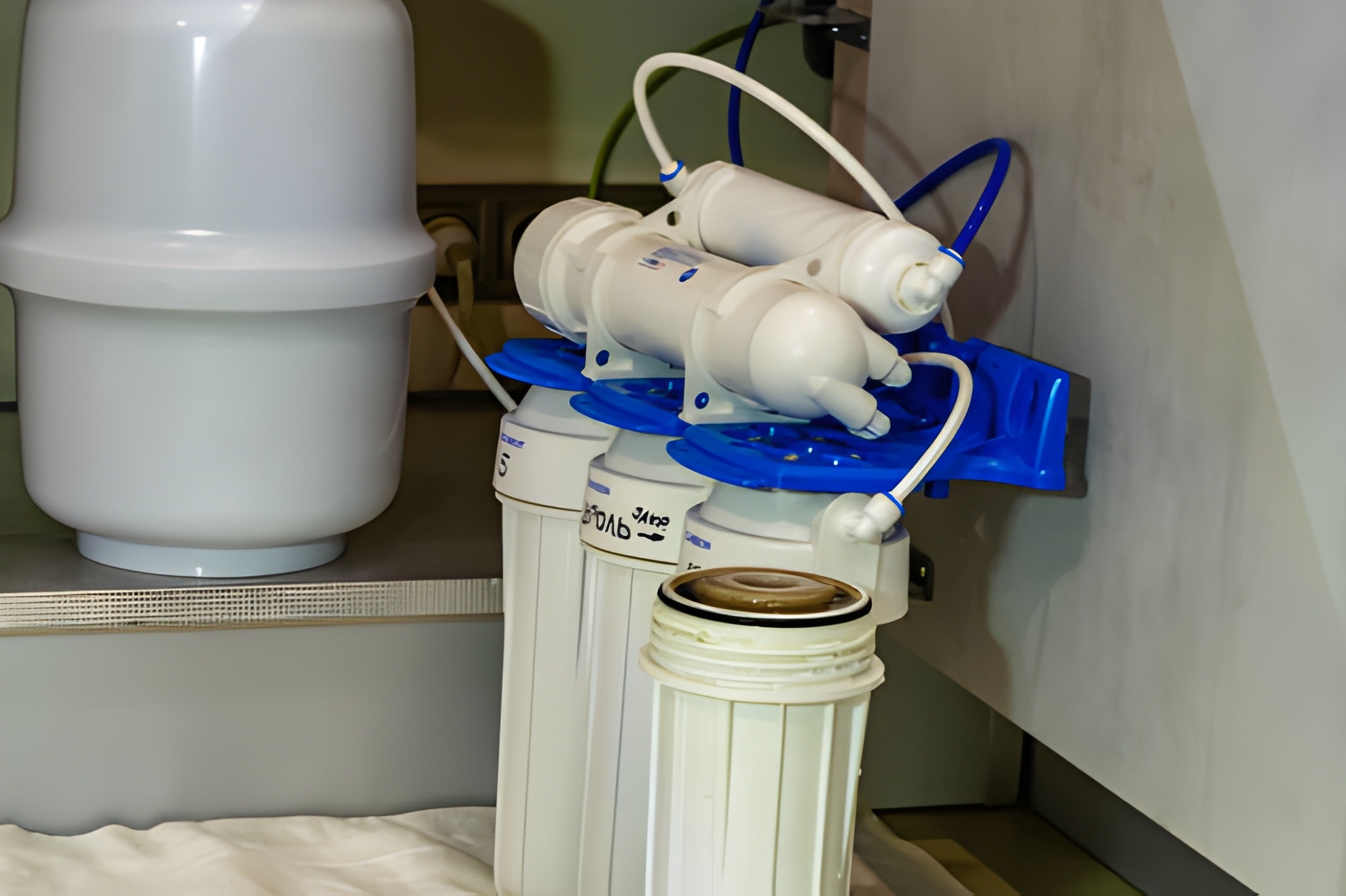
How RO technology removes contaminants
- Pre-filtration: Sediment and carbon pre-filters remove particles, chlorine, and organics that can foul the RO membrane.
- RO membrane: The semipermeable membrane rejects dissolved salts, heavy metals (lead, arsenic, chromium), nitrates, fluoride, and many VOCs, sending concentrated waste to drain while allowing purified water to a storage tank.
- Post-filtration and remineralization: A final carbon or mineral filter polishes taste and can add back healthy minerals for balanced flavor and pH.
RO is not a single-step filter; it is a multi-stage system where each component protects the membrane and ensures the best water quality.
Under-sink vs whole-home RO: which is right for Newbury Park homes?
- Under-sink RO
- Best for: drinking and cooking water.
- Pros: lower cost, compact footprint, straightforward installation, minimal water usage impact on the rest of the house.
- Cons: does not protect showers, dishwashers, or washing machines from dissolved solids.
- Whole-home RO
- Best for: properties with well water, very high TDS, or where dissolved solids are damaging appliances and fixtures.
- Pros: protects all water outlets, extends appliance life, eliminates scale and mineral staining throughout the home.
- Cons: larger footprint, higher installation complexity (often requires booster pump and pre-treatment), greater daily wastewater volume.
Many Newbury Park homes on municipal water find an under-sink RO adequate for potable water needs, while rural properties or homes with known high-TDS well water may require whole-home treatment.
Professional water testing and system sizing
A reliable RO design begins with a thorough water analysis and on-site assessment:
- Collect municipal or well samples for lab testing to identify TDS, hardness, chlorine, nitrates, metals, and any site-specific contaminants.
- Measure feed water pressure and flow rate at likely installation points.
- Review household drinking water demand and usage patterns to size membrane capacity and storage tank volume.
- Inspect available space under sinks or in mechanical rooms and identify drain access and electrical needs (for booster pumps).
Accurate testing ensures the selected membrane size (gallons per day), pre-filter types, and pump requirements match your Newbury Park home’s conditions.
Professional installation steps
- Complete site inspection and confirm water sample data.
- Shut off and drain the installation area, verify pipe materials and accessibility.
- Install pre-filters (sediment and carbon) in accessible housings to protect the membrane.
- Mount the RO membrane housing and connect with appropriate tubing and drain saddle.
- Install pressurized storage tank and dedicated drinking water faucet or tie into existing fixtures where appropriate.
- Add booster pump if incoming pressure is insufficient; wire per code.
- Sanitize system, perform leak checks, and measure output TDS to confirm performance.
- Provide a system walkthrough explaining maintenance intervals and operation.
Under-sink installs typically take a few hours; whole-home systems can take one day or more depending on complexity and pre-treatment needs.
Routine maintenance and filter replacement
- Sediment and carbon pre-filters: replace every 6 to 12 months, sooner in high-sediment or high-chlorine water.
- RO membrane: expect replacement every 2 to 5 years depending on feed water quality and usage.
- Post-filter and remineralizer: replace annually.
- Sanitization and tank service: recommended annually to prevent bacterial growth and ensure taste.
- Annual performance check: test TDS and pressure to identify degrading performance early.
Regular maintenance protects the membrane and keeps output water within desired quality parameters.
Common troubleshooting and repair scenarios
- Low product flow: check feed water pressure, clogged pre-filters, or a failing storage tank bladder.
- Increased TDS in product water: membrane failure or exhausted pre-filters; confirm with a TDS meter.
- Continuous drain flow: faulty automatic shutoff or check valve issues.
- Foul odor or taste: replace carbon filters and sanitize the tank; check for biofilm.
- Noisy pump: loose mounting, air in lines, or pump wear.
Simple homeowner checks (filter age, visible leaks, and TDS readings) can identify many issues; complex problems or pump/electrical repairs should be handled by a licensed technician.
Warranties and financing options
RO components commonly carry manufacturer parts warranties and installations often include a workmanship warranty. Coverage varies by component and model; compliance with recommended maintenance schedules is typically required to keep warranties valid.
Financing options are often available through payment plans or third-party programs that spread cost over time. Many homeowners use low-term financing or monthly payment plans to make higher-capacity or whole-home systems more affordable. Camarillo Plumbing can explain standard warranty terms and typical financing structures during the consultation.
What to expect from a consultation or estimate in Newbury Park, CA
- Schedule an on-site assessment where a technician inspects the water source, takes samples if needed, and evaluates plumbing access and space constraints.
- Review testing results and discuss tailored system options (under-sink vs whole-home), maintenance expectations, and warranty coverage.
- Receive a written estimate that outlines system components, installation scope, estimated timeline, and maintenance schedule.
- Prepare for the visit by noting whether your home is on a well or municipal supply, identifying problem faucets or appliances, and clearing access under sinks or in mechanical spaces.
Technicians will provide a clear breakdown of the system design rationale and ongoing service recommendations specific to Newbury Park water conditions.
Ongoing benefits and practical tips
A properly designed RO system delivers consistent, great-tasting water, reduces bottled water dependency, and protects drinking water quality for cooking and infant formula. For Newbury Park residents, RO can address common concerns from municipal residuals, local distribution line sediment, and well-related contaminants. Practical tips include keeping replacement filters on hand, scheduling an annual performance check, and monitoring TDS readings after long periods of nonuse to ensure continued protection.
Q: How long does a typical under-sink RO installation take?
A: Most under-sink installations are completed in 2 to 4 hours, including setup, sanitization, and initial performance testing.
Q: Will an RO system remove chlorine and improve taste?
A: Yes. Carbon pre-filters remove chlorine and many organic compounds, while the RO membrane reduces dissolved solids that affect taste. A post-carbon filter polishes flavor.
Q: Is whole-home RO necessary if I only want better drinking water?
A: Not usually. Under-sink RO is the most cost-effective solution for drinking and cooking water. Whole-home systems are recommended when feed water has very high TDS or when mineral damage to appliances and fixtures is a concern.
Q: How will I know when filters or the membrane need replacement?
A: Regular maintenance intervals are the primary guide. Signs that service is needed include reduced flow, rising TDS readings, bad taste or odor, and visible pressure changes. Regular annual checks help catch issues early.
hear what our satisfied clients have to say